
Know Calhoun Deed Instruments
The Chancery Clerk keeps Calhoun County deed records. A deed moves an interest in land, but plenty of neighboring filings do other work. Some secure a debt. Others correct an earlier filing or release a claim. Some document the authority of a trustee or estate representative. Read the instrument type before treating any hit as a true conveyance.
| Deed type | What it does | Common record use |
|---|---|---|
| Deed | Records a conveyance between grantor and grantee | Identify the stated transfer and legal description |
| Release deed | Records a release tied to a prior interest | Follow an encumbrance or claim to its release |
| Executor or administrator deed | Transfers land under estate authority | Connect probate authority to the parcel chain |
| Trustee deed | Records a transfer made by an authorized trustee | Review a trust or sale sequence with its source instruments |
| County or city tax sale deed | Records a tax-sale related transfer | Check the tax process and later redemption or deed filings |
Deeds of trust, assignments, substitutions, releases, liens, lis pendens, corrections, powers of attorney, plats, and notices all appear under the same inquiry roof. They help explain the chain. Just remember that not every one is an ownership deed.
Search Calhoun Deed Records
Start online with the DuProcess official land-record inquiry. Enter a name in last-name, first-name order, then pick the transferring side, the receiving side, or both. That covers most name searches. For other paths, the system offers dates, book and page, instrument number, instrument type, legal text, subdivision, parcel fields, section-township-range, square, block, lot, patent, and quarter-section controls.
| Index field | How to use it | What to verify |
|---|---|---|
| Name and direction | Try variants on both party sides | Which returned person is grantor or grantee |
| Date range | Narrow common names | Recording date, not merely deed-signing date |
| Book, page, instrument | Retrieve a cited filing | Exact page span and status |
| Legal or subdivision | Find a tract when names change | Lot, block, plat, or rural description match |
| Parcel ID, Parcel Num, PPIN | Test each saved key separately | Do not assume the three fields are synonyms |
A result can show parties, instrument type, filing date, page count, document status, parcel references, ZIP, legal description, consideration, and related instruments. The courthouse index remains the official record. The official land-index form displays the search surface used for Calhoun County deed records.
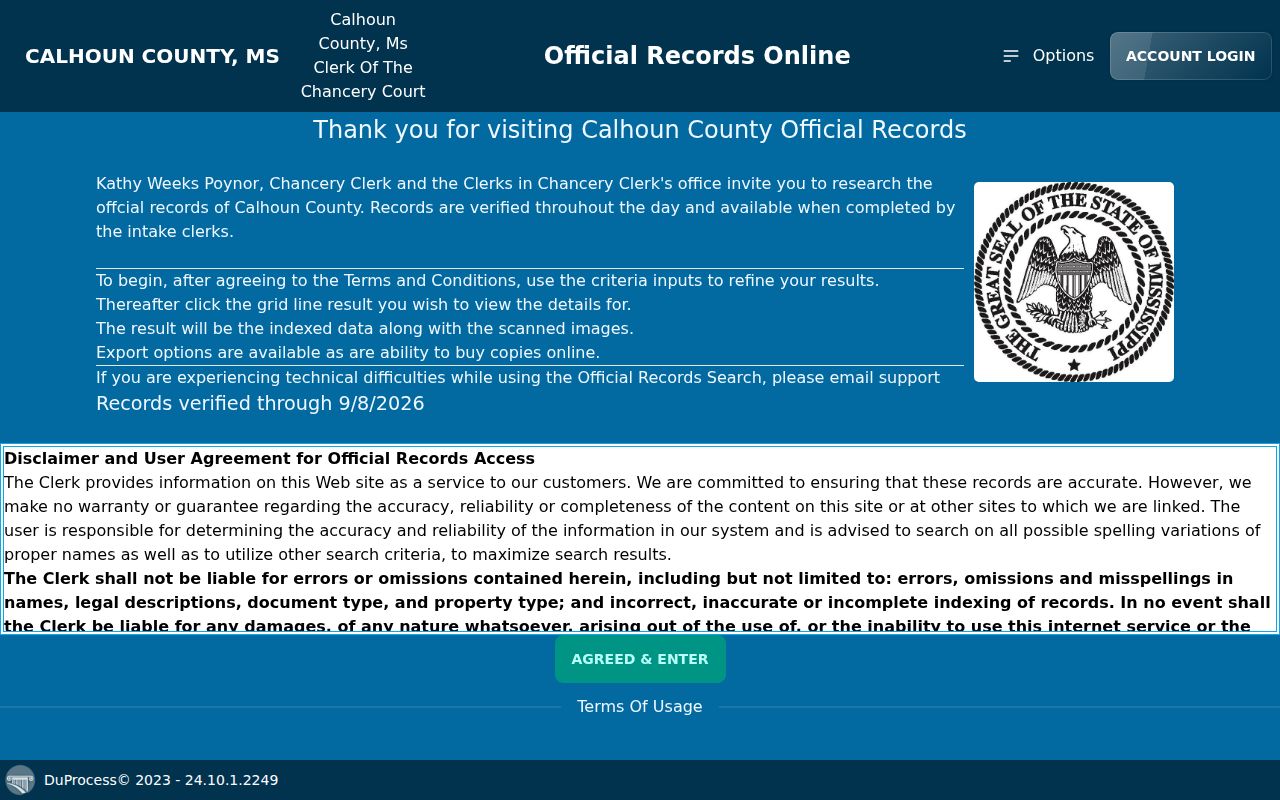
The legal and parcel controls make the screen useful after a name search grows too broad.
Follow Calhoun Grantors and Grantees
A chain of title is the ordered series of instruments that transferred a tract. The grantor conveys the interest. The grantee receives it. A reverse search starts with the newest confirmed deed and follows the prior owner backward.
- Find the newest deed by parcel reference, legal description, or current party name.
- Read the grantee and confirm that the legal description matches the subject tract.
- Take the grantor from that deed and search that party as an earlier grantee.
- Compare each cited prior instrument, subdivision, block, lot, and acreage before stepping back again.
- When the online index stops, request the older grantor-grantee and deed books at the Chancery counter.
- Grantor
- The party that conveys the stated land interest.
- Grantee
- The party that receives the stated interest.
- Chain of title
- The linked transfer history for the same tract.
- Book and page
- The volume and page location of a filing.
- Instrument number
- A document identifier assigned when a filing is recorded.
A Bruce Deed Trail
A 2026 Calhoun Journal legal notice offers a compact example. It shows how Calhoun County deed records relate to each other. It cites a deed of trust recorded January 18, 2018 in Book 397, Page 447, Document 2018000113. A later substitution appears in Book 472, Pages 408 through 410, Document 2026000110. That one was filed January 16, 2026. Two filings, one property, a decade apart.
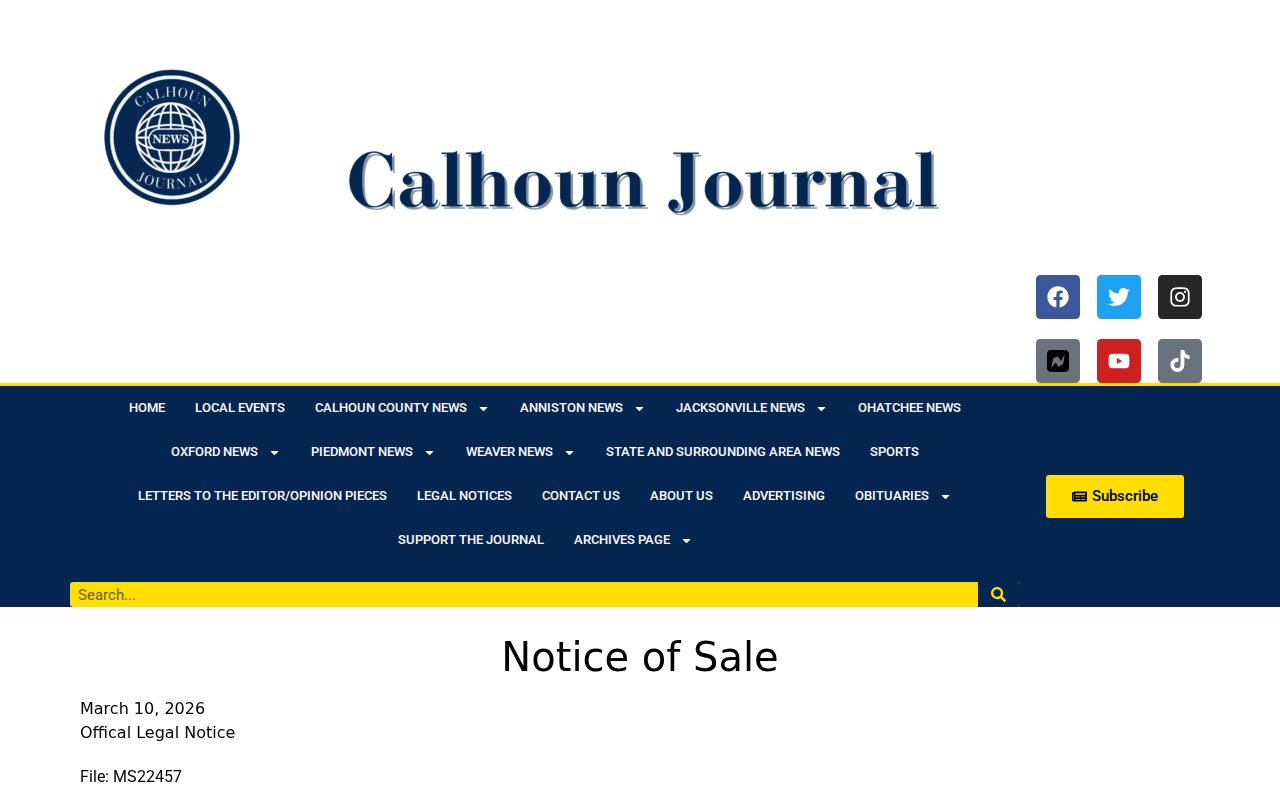
The notice ties both filings to Lot 28 of the Spratlin-Bennett re-plat, City of Bruce Block 117, and a Circle Drive address. Treat it as a search lead only. It is not the official deed image, nor proof the announced sale ever closed.
Read Calhoun Trust Sequences
A deed of trust records a security interest, not a new owner transfer. Later paperwork often follows it. Look for assignments, modifications, partial releases, releases, and substitutions of trustee. Search under the same parties or the same legal description. A substitution can name a new trustee. It may leave the underlying title question untouched.
Foreclosure research also pulls in Chancery filings, courthouse posting, and the newspaper notice. A lis pendens or case entry signals litigation affecting land. Only the filed order, deed, release, or sale confirmation answers the next step. Calhoun Chancery MEC began electronic access in 2023. It requires login. The clerk remains the fallback for case material you cannot reach.
Calhoun Land Books Beyond Web
The Land Title Association reports online land records from 1984 forward. That year marks digital availability, not the birth of the archive. Calhoun County formed in 1852. Earlier deed and plat books must be confirmed with the Chancery Clerk. For historical context, MDAH Series 1202 lists Calhoun land material in several years from the 1850s through the 1880s. Those archive counts refer to listed items rather than modern parcels. No official source confirms a courthouse fire or mass-loss story. Treat gaps as access or catalog questions unless a custodian identifies a specific lost book.
The MDAH collection includes land entries for 1852 and 1856. It holds personal-property material for 1860, land material for 1861, and later land or personal series in 1868, 1870, 1875, 1879, 1884, 1885, 1887, and 1889. These are archive item runs, not a complete deed index. The separate MDAH tax-roll catalog reaches earlier periods and warns that some 1868/69 lists did not survive. Neither source supports claiming a missing deed was destroyed.
A pre-1984 chain should start with the last matched online instrument. Record its grantor, grantee, date, legal description, consideration, book and page, instrument number, and every cited prior deed. Search spelling variants and plat terms before asking the clerk for the older book. A subdivision may have been re-platted, renamed, or divided. A lot label can change while the parent tract stays connected by metes-and-bounds language.
Online boundary. The reported 1984 start does not mean older deeds do not exist; request the physical index and books in Pittsboro.
Electronic Calhoun Deed Filing
A 2024/2025 CSC vendor bulletin says Calhoun County is electronically recording documents. That update concerns submission workflow. It does not mean every old volume is imaged. Not every deed type can go through the vendor either. Confirm accepted document types, county fees, vendor requirements, and current turnaround with the Chancery Clerk before submitting. The online inquiry and the electronic recording channel serve different jobs. One finds indexed records. The other sends new instruments for recording.
Order a Calhoun Deed Copy
The DuProcess landing page lists the payment terms for online deed copies. Cards are accepted, with a 3.5 percent service fee and a $2 minimum. Purchases are final and non-refundable. Image price and availability vary by record.
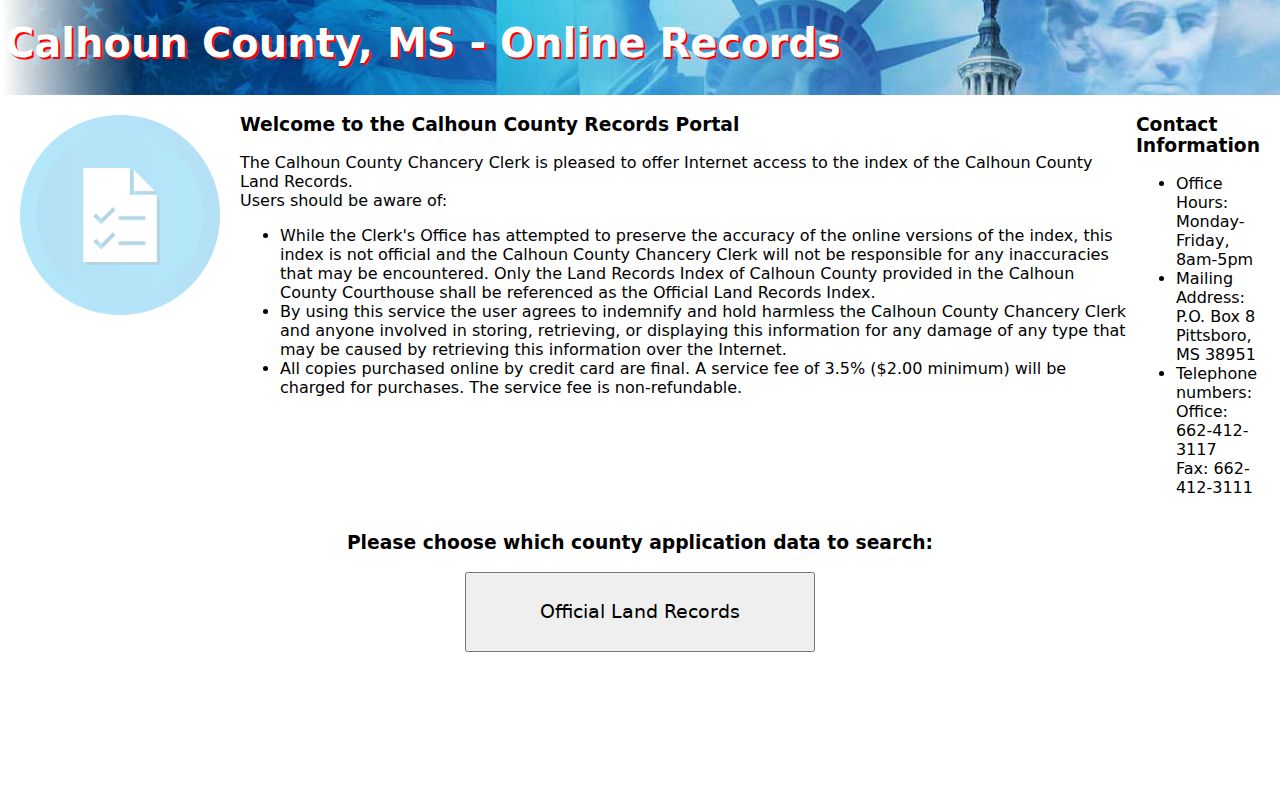
When a deed image is missing from the portal or you need a certified copy, the notice points you back to the official courthouse index for Calhoun County deed records.
To order, call Chancery Clerk Kathy Poynor at 662-412-3117 or write PO Box 8, Pittsboro, MS 38951. Include the instrument number or the book and page, both party names, the record type, and whether you want certification. No fee schedule appears online, so request current per-page and certification costs before ordering. The public counter sits at 103 W Main Street, Suite 192; hours vary, so confirm them before you drive over.
Recorded, not guaranteed. An indexed Calhoun deed is not a title opinion, and an unrecorded claim may not appear. Seek qualified title help when legal reliance is required.
Request Missing Calhoun Instruments
An older book, a missing image, or an unposted index can stand in your way. Ask the clerk to search a narrow party and date span. Give them the parcel key, subdivision, lot and block, section-township-range, and any prior citation. Request an electronic copy when one exists. If material is withheld, ask why. Estate transfers can take a second channel. The Chancery land index holds affidavits, orders, executor and administrator deeds, and related filings. From there, request the probate docket or file by decedent and approximate year. A will or estate inventory shows who had authority. But the later recorded deed is what ties that authority to the parcel. Calhoun Chancery MEC has run electronically since March 20, 2023. The system requires an account, and it does not make every image public. The Mississippi Public Records Act allows inspection or copying of non-exempt records. Absent a local procedure, access is generally due within one working day. A procedure cannot stretch past seven. Charges may cover actual search, review, duplication, and mailing costs. Court seals and other exemptions still apply. Sometimes you need a parcel or a party clue rather than a known deed. For that, the broader Calhoun County property search is the better start.